
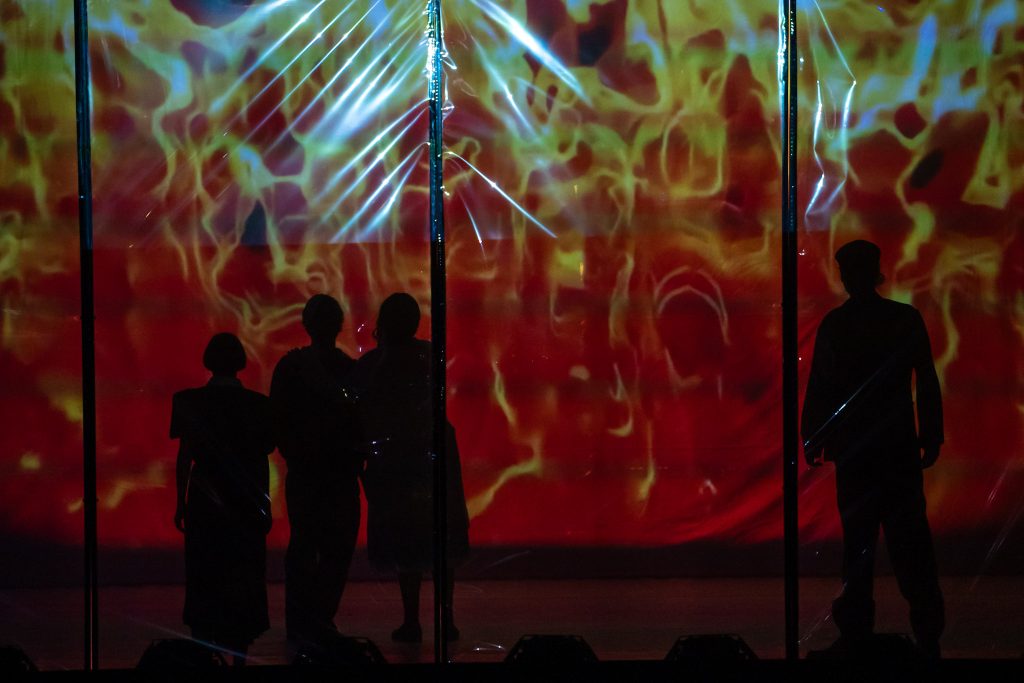
On the 4th or 5th of October, 2023, a few days before the war in Gaza began, I saw a play at the MESS Festival called The Handke Project. On the night, I was thinking about the shooting that had just occurred in Kosovo, at the monastery in Banjska. I thought I might write something quick about the Kosovar-led production, but never that I still would be more than two years later.
As its title suggests, The Handke Project was written in response to the Austrian author’s 2019 receipt of the Nobel Prize for Literature. The play, written by Jeton Neziraj and directed by Blerta Neziraj, certainly did take Peter Handke to task for his support of the Milošević regime and consistent denial of the war crimes it perpetrated. But the thrust of its critique was leveled at a different target: the hypocrisy of a European establishment that could grant a genocide denialist the highest literary honor in the world—and do so without even pausing its avowals of the importance of human rights and democracy, the importance of countering misinformation, all the rest of their progressivism.
The trigger keeping The Handke Project on my mind was the European hypocrisy on display throughout Israel’s genocide in Gaza. The formula is, of course, more than familiar to the Balkans and is always the same: ‘one set of standards for us, another for you over there.’ Early in Israel’s attacks on Gaza, statements Von der Leyen had previously made about Russia’s attacks on Ukraine’s civilian infrastructure amounting to “acts of pure terror” began to recirculate on social media—highlighting the lack of a similar statement in response to the IDF’s targeting of Gaza’s power, water, and health systems. The silences and equivocations, from the entire apparatus of the European Union, never stopped.
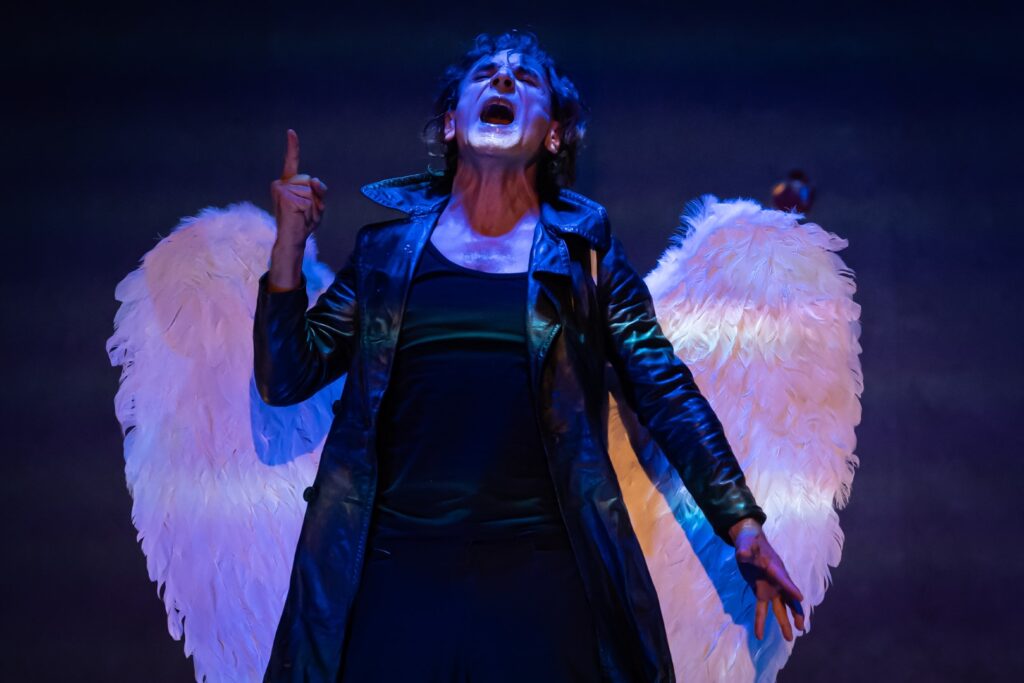
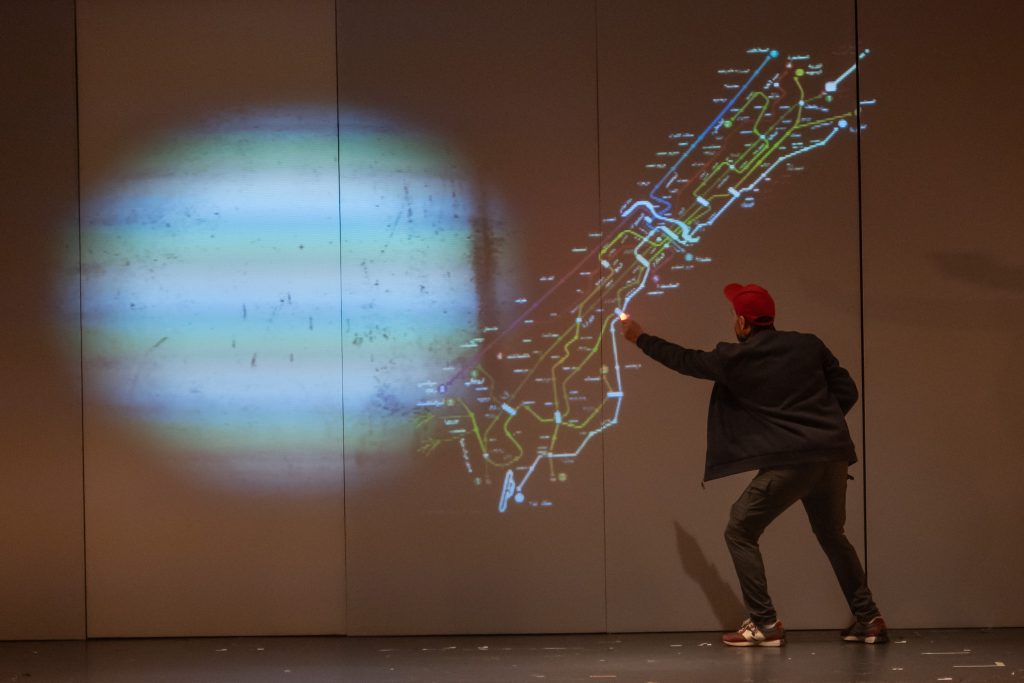
Yet, equally, the MESS festival never stopped questioning the callousness with which the powerful spoke and acted. Not only did the 2024 edition feature an outline of Gaza on cracked, desert ground, but its opening play was Metro Gaza (produced by Hervé Loichemol and the Freedom Theater, a troupe from Jenin in the occupied West Bank). Several events and talks took up the question of Gaza both during the festival, and during the mid-year “Memory Module” Programme. They took a consistent stand at a time when both organizations and individuals were being penalized for similar.
The MESS Festival, itself, has something to tell us about Europe and the world’s response to the genocide in Gaza. Many readers will know that the festival’s modern form was created during the siege. In 1993, playwright and director Haris Pašović revived the preexisting Festival malih i eksperimentalnih scena Jugoslavije in what would become a key episode in the ‘artistic resistance’ to the war. That festival featured local stagings of Euripides’ Alkestis, Sophocles’ Ajax, and other plays, as well as contributions from Susan Sontag and Peter Schumann.
The art and culture produced in war-time Sarajevo had a dual audience. It was for the people within the city, but also acted as a signal to those outside. Here is Sontag, writing in 1993:
Newspaper and radio reporting and, above all, TV coverage have shown the war in Bosnia in extraordinary detail… [But,] I do not believe the standard argument made by critics of television that watching terrible events on the small screen distances them as much as it makes them real. It is the continuing coverage of the war in the absence of action to stop it that makes us mere spectators.
She reported on a hope within the city that stories about the survival of art in the city could cut through the repetitive stories about the suffering of innocents shown to the West. Yet there was already a growing awareness that mere visibility—either of crimes or the art produced in spite of them—would not necessarily lead to action; even though nobody had an excuse to be unaware of what was happening.
If the media saturation of the war felt new in the 90s, I can’t imagine what the information and images from Palestine would look like to people from that time. Pictures and videos are taken on smartphones and spread over social media, viewed tens of millions of times within hours of being taken. No editors are consulted and no broadcast audiences are protected from seeing the consequences of airstrikes on a trapped population. Protecting one’s ignorance requires an intentional turning away. Thankfully, though, very few people have chosen ignorance; the vast majority were horrified and wanted the violence to stop, many thousands took direct action. Yet, as Sontag observed in the 90s, public outrage does not have the power to create “a will to intervene by those few people in the world who make political and military decisions.”
In the programme of the 2025 festival, Nihad Kreševljaković, the current director of MESS, pulled on a similar thread when he asked, “Who do we trust: those in power or people who speak from the heart of reality of the world we inhabit?” Those with the power to stop, or, indeed, to create, violence should not be trusted; obviously not. But their lies have power, the effects of which Kreševljaković describes while tracing what he sees as the role of theatre in confronting them: “As the world loses its face, as its essence fades and form becomes a means to insult intelligence, theatre reminds us that it is in the face of the other that we best see our own humanity.” Even more directly, he writes that the MESS festival “offers what contemporary society lacks the most—empathy.”
Truth and empathy are closely tied, here. We cannot expect truth from those with power because we cannot expect empathy from them either. To aim for power is to aim to remove oneself from the “heart of the world we inhabit,” it is a desire to stand above reality and shape it. And hypocrisy is the ultimate confirmation of that equation, since both the world and the nature of one’s own actions are denied. But empathy is destructive to hypocrisy, because feeling the emotions of another forces accountability to others sharing the world. That’s why people driven by power work so hard to tamp it down—if they are not psychopathic enough to lack the sense entirely. Expecting empathy from such people would be like expecting kindness from a snake.
The more crucial fact, for me, is that the vast majority of the world has had empathy, seen clearly that the events unfolding in Gaza were a genocide and had to be stopped immediately. Despite that agreement, the disaster was allowed to unfold over a period of years. We (Europeans) are supposed to live in democratic societies, but the fact that the ‘general will’ has clearly and always been with the Palestinian cause has not led to action from our governments. In a more coherent world, the outpouring of pro-Palestinian activism would have brought the bombing to a stop without so much death, led to a better outcome than the wavering ceasefire that holds at the time of writing. But it has not.
If the actions we collectively take are not powerful enough to force the powerful to act according to their own standards of human rights, etc., etc., what are we to do? Another thought from Kreševljaković, given some years ago during a panel discussion, might give us an idea of the festival’s response to that question:
Having the experience of wartime Sarajevo, I formed my belief that real beauty lies in the fact that artists and cultural workers and intellectuals can believe in utopian things. It doesn’t matter that things don’t look real at all. We have an obligation to believe in our capacity—and I’m aware of how cheesy this may sound—to change things from what they are now.
It’s a quote worth looking closely at. Notice that the “obligation to believe in our capacity… to change things” is not limited by the reality of whether change is possible. Utopias, after all, do not (and cannot) exist by definition—that’s precisely why it’s beautiful that “artists and cultural workers and intellectuals” believe in them. And, to extend the thought into the current frame: even if the prospect of a world wherein the empathy of people can change the world seems utopistic, we can at least expect artists, of all people, to believe in it and to hold themselves above the hypocrisy of the powerful.
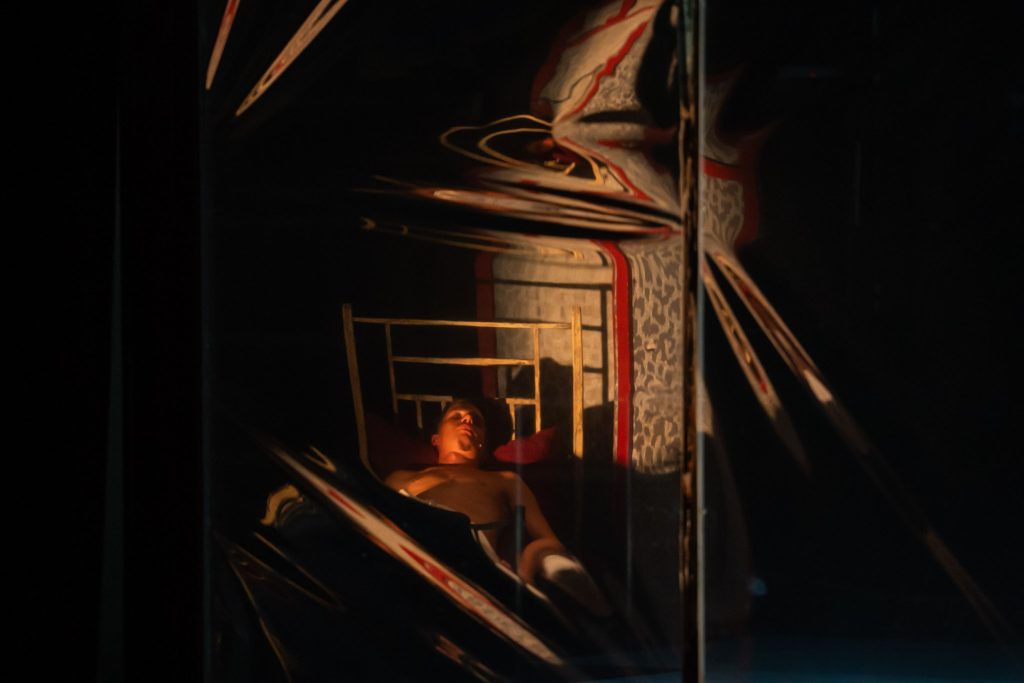
Interestingly, a play I saw at this year’s edition of the festival seemed to present a different reaction to the incoherence of the world: Mirror, directed by Bülent Özdil and based on Andrei Tarkovsky’s film. It was an imperfect play, with strong moments undermined by the strange and constant use of AI-generated video, but succeeded in feeling like Tarkovsky—not a small achievement. It portrayed a Tarkovskian hero; a man who has become lost within himself, not from an ignorance of the world but a sensitivity to it. The protagonist, on his deathbed, releases a stream of memories and impressions that contain their own internal logic and illogic, their own connections to each other and to reality. This type of hero rejects the world as it exists, chooses the passivity of dreams and madness.
The Russian auteur, living in vastly different but perhaps no less hypocritical times, was no less aware of the way that ‘politics’ had no place for the individual. He was suspicious of “the ‘Grand Inquisitors’, leaders, ‘outstanding personalities,’” who wished to, in his words, “possess the consciousness of the masses, instilling them with new ideological and social ideas.” It was in opposition to these assaults that his characters showed their strength:
I have always wanted to tell of people possessed of inner freedom despite being surrounded by others who are inwardly dependent and unfree; whose apparent weakness is born of moral conviction and… is a sign of strength.
The rejection of what those who are “inwardly dependent and unfree” pretend to care about for their own advantage is a spiritual act, for Tarkovsky. By refusing to simply take what is given by society, there is a faith—a mad faith—that more is possible. But here we have returned to Kreševljaković, for what requires more faith and more madness than believing in utopias?
I will conclude by noting that there have unfortunately always been artists and writers that have failed to meet our expectations; Handke is one of many who have used their talents in service of lies. Creative or not, all of us have faced the question of how to respond as individuals to the historical crime that Israel has perpetrated. “In the fight for your own soul, fidelity to yourself demands unceasing, singleminded effort,” wrote Tarkovsky. The MESS Festival has held itself to its own standards. And in so doing, made the idea of a world without hypocrisy seem slightly less utopian.
***
References
Speech by President von der Leyen at the European Parliament Plenary, EU Commission Archive, October 19, 2022.
Susan Sontag, “Godot Comes to Sarajevo.” The New York Review of Books, October 21, 1993.
Nihad Kreševljaković, “While the World Burns: Stories Still in Search of Humanity.” Program of the 65th International Theatre Festival MESS, 2025.
Dolecki, J., Halilbasic, S., & Hulfeld, S. (Eds.), Theatre in the Context of the Yugoslav Wars. Springer International Publishing – Palgrave Macmillan, 2018.
Andrei Tarkovsky, Sculpting in Time (Trans. Kitty Hunter-Blair). University of Texas Press, 1986.