
You usually write about cultural events after they happen, especially ones like the concert that will take place at Stadion Grbavica in a few days. The meanings of such nights mostly lie in experiences. We’re talking about music played in a certain time and place, in front of specific people, forming an arrangement that will never exist again.
There are, however, concerts that stand for more than the night on which they are held and take on an almost mythological importance. Jimi Hendrix at Woodstock is a classic example, but here, there’s the famous show that Bruce Dickinson of Iron Maiden played, and U2’s 1997 concert as well. The symbolic significance exceeds the experience of those who were there, allowing everyone—who were there or not there—to feel as though it is part of their personal history.
It’s impossible to know whether the Prodigy show will come to have that kind of importance. We’ll know whether or not it was a good show the morning after, but it’ll take 20 years to figure out whether or not it was historical.
★★★
Generationally speaking, context suggests The Prodigy show will be important. A concert of this profile hasn’t been held in Sarajevo for some time; for long enough that many who have already finished university and began working have never seen a proper stadium show in their city (Merlin and Bešlić aside). People are ready for it, both those old enough to remember Sarajevo as a significant destination for music on a global level and those young enough to only have experienced it second-hand.
And it is also Prodigy. We all grew up listening to them, to Firestarter and Breathe and Their Law, and the songs are as hard and as out of step with the mainstream world as when we were young. There are very few bands who would have been exciting to see in the post-war years when Sarajevo was regularly visited by international bands and DJs, and are still capable of being exciting today.
There’s a fittingness to it being The Prodigy who (hopefully) open an era wherein these types of concerts are once again possible.
★★★
The Prodigy has already played a properly historic show, at the level described above, in our region.
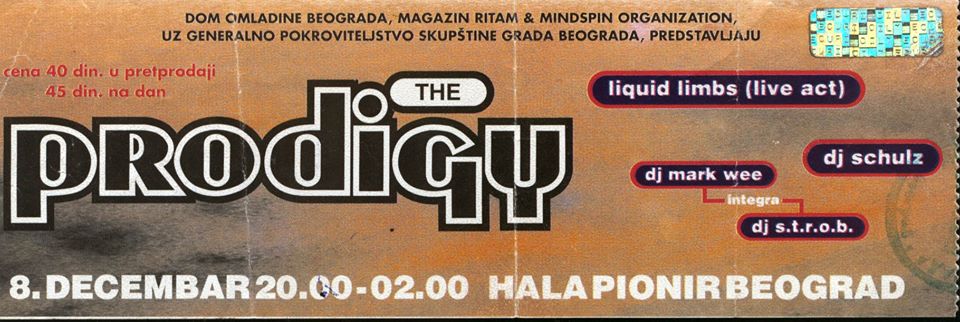
In Belgrade, in December 1995. They were the first international act to travel to the country since the breaking of Yugoslavia, playing in front of 10,000 at Hala Pionir a couple of weeks after the signing of the agreement in Dayton.
The Milošević regime was still under sanctions at the time, and the government tried to use the event for any propaganda value they could. But they couldn’t pull it off, holding a sublimely awkward ‘press conference’ in which the band was given honorary citizenship of the city of Belgrade and asked, on the spot, to sign a pledge “against drugs” in electronic music. Keith Flint made an awkward grimace, and then looked into the television cameras and stuck out his tongue.
They said a couple words of thanks, and then left to play what was an exceptional party, by all accounts. It was the first time Breathe was ever played, and only the second time they played Firestarter. The public memory holds the audience lighting flares (shocking the band) and the image of a girl pulled from the crowd to dance alongside Flint and Leeroy Thornhill. Those experiences live on.
★★★
Prodigy also fit the role they took in Serbia. It was an aggressor state, guilty of war crimes and genocide, and the band would have committed to playing the show months before the technical end of the war at Dayton. One must read the decision to play there as a political choice, necessarily, based on the context.
Liam Howlett, however, has consistently said that his band is not political in many different interviews over the course of decades. “We’re not a political band, we’re an escapism band,” for example (in the BBC in 2018).
This seems to be a surprising stance from artists who produce music that seems so freeing and anarchic. Firestarter was and is a song that’s searching for a revolution. It makes more sense, though, if you think of their rejection of the mainstream standards of society as including all the political stances available for easy adoption.
Within such a dynamic, alternativity as a genuine response to everything around oneself is opened, but this desire to escape can never stop escaping. Yet the truth is that we can never actually escape our world, wherein we must all walk politically (whether or not we want to). At the same time, that truth doesn’t mean the desire to escape is not a natural one, nor that it is always wrong, nor even that it is meaningless.
★★★
The fact that the Prodigy refuses to be straightforwardly political is part of the reason why they couldn’t be co-opted by the powers that were in 1995, but could act as a soundtrack for Otpor (the youth movement against Milošević) in the years that followed. And that quality is why their music still feels vital today.
The Prodigy went to Belgrade in wartime, and they made a mess and they played a show that allowed 10,000 young people for a night to escape the terrible, schizophrenic, politics that obtained in the ‘SRJ’ of the time.
One can judge their appearance; the moral grounds to do so exist. But this seems to me one of the gray areas within the collision of art and politics because of the specificity of The Prodigy’s music and attitude. They played in the wrong place, but in the right way—in a way that could not be captured, that exposed cracks in the ideological facade of the place they occupied for a night.
This could only be done by a band like The Prodigy, whose artistic output held (and still holds) a different type of power than the linguistic statement, the manifesto, the petition.
(Otpor kao iskustvo i osjećaj, ne kao izreka.)
★★★
This is ultimately not a story about Belgrade in 1995, but about Sarajevo in 2026, which is why I want to end by remarking that the type of energy the Prodigy represents is needed here. Momentary lapses of thought to feel—to Breathe—are valuable and necessary, and experiences that engender escape can and should be sought.
I also have to reiterate that writing so much in expectation of a show is not necessarily smart—no one can promise the type of significance we’ve been examining. To focus too much on such questions as these risks missing the true point of simply enjoying a night, such that it can form a memory in the future for oneself or all of us.
Concerts can also be historical in a more modest and material sense: they can demonstrate what is possible in a business sense, provide lessons and resources to their organizers, and convince someone to invest in the next one. In this frame, I think it’s necessary to express respect for the ambition and the drive of Garden of Dreams, the organizers, and also necessary to support the existence of such initiative in Sarajevo.